Polson, Montana (pop. 5,100), sitting in the northwestern part of the state, is enveloped by a serene, natural environment which includes Flathead Lake, the largest freshwater lake west of the Mississippi. Not surprisingly, Polson is a popular place for retirees looking to settle down and escape into a calm, rural life.
Just over 1 in 5 Polson residents is over the age of 65. And North Lake County Public Library (NLCPL) in Polson recognizes its obligation to that community.
One of the library’s key goals, NLCPL director Abbi Dooley told Knology, is to “make sure that we are able to best serve those who choose to live their remaining days in our beautiful area.” Aware of the fact that “with an aging population come various health issues,” NLCPL has become the first library in Montana to install a hearing loop and a Lucynt projector, assistive technologies have made the library more accessible to individuals with hearing loss and dementia. And they did so with help from a Libraries Transforming Communities (LTC): Accessible Small and Rural Communities grant from the American Library Association (ALA).
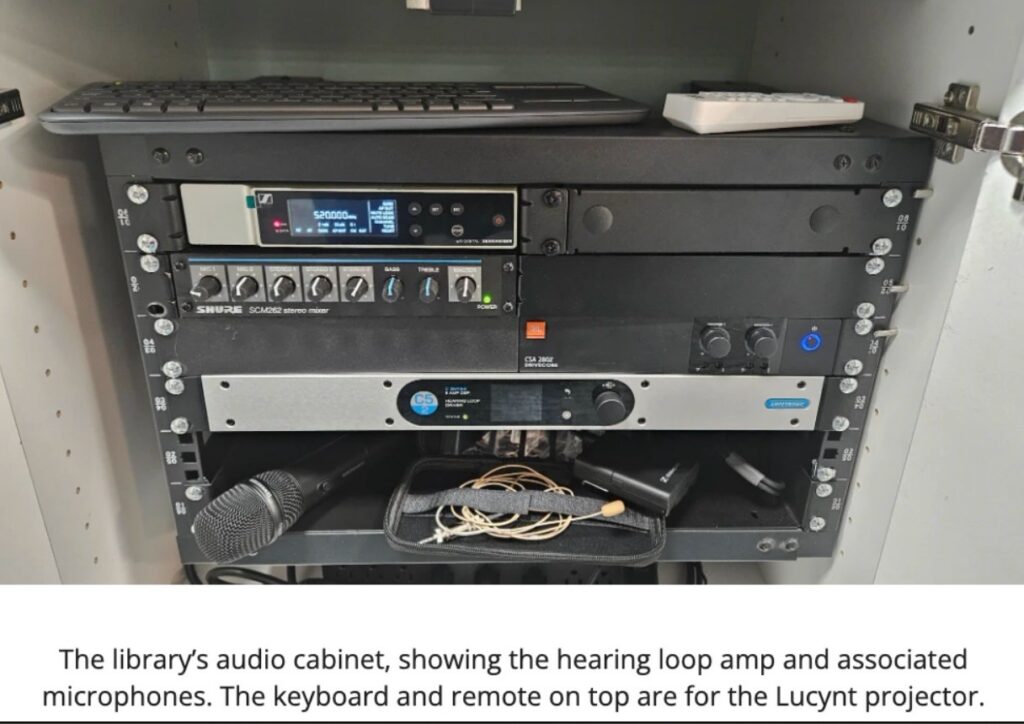
Dooley first learned about the LTC grant initiative in 2023, when NLCPL was breaking ground on a major renovation to make the building fully ADA compliant. In response to feedback from patrons with hearing-related disabilities, Dooley and her staff began to investigate ways to upgrade the library’s sound system and hit upon the idea of installing a hearing loop. A hearing loop uses underground copper wires to transmit sounds from a microphone through the telecoils (t-coils) in hearing aids and cochlear implants. When installed in public venues, hearing loops improve clarity and understanding by amplifying speech and reducing background noise.
The hearing loops worked directly with the library’s goal: ensuring that hard-of-hearing patrons would be able to clearly hear speakers in the library’s community room as well as communicate with staff at the circulation desk.
Upon receiving LTC funds in 2023, NLCPL hosted a community conversation about hearing loops with demonstrations. All attendees either used assistive hearing technologies themselves or had a spouse who did. After seeing how commonplace the technology is in other countries (where public spaces like grocery stores, schools, and libraries are often required to have hearing loops installed), everyone quickly rallied around the idea. The community conversation gave the library the support needed to move the project forward.
As the library was already closed for remodeling, the timing for installing hearing loops couldn’t have been better.
“It was just a natural tie-in since we would have the floor all ripped up and needed to put down new carpet,” Dooley recalls.
Dooley says the installation went smoothly, and with the passage of time, NLCPL has figured out how to promote and integrate the hearing loop into its programming efforts. To ensure proper use of the technology, staff talk to both presenters and patrons about the loop—and the need to make use of microphones. As hearing aids need to be adjusted by an audiologist before they can be synced up with the hearing loop, NLCPL also provides headphones and handheld devices to anyone who wants them. Some prefer this approach.
Speaking of one patron with hearing loss, NLCPL assistant director Mallory Witham explains how “he never wears his hearing aids, but he loves coming to programming here because he can use the headset.”
The best thing about the hearing loop is that patrons can use it discreetly. As the library learned from its community conversation, hearing loss is “one of those things that people are often embarrassed to admit they have.” With the hearing loop, patrons can avoid these embarrassing situations.
Adding dementia-friendly technologies
NLCPL’s success with the hearing loop inspired the library to apply for a second LTC grant to acquire a projector made by Lucynt that is designed specifically for people with dementia and other cognitive disabilities. Offering access to more than 160 games that promote social interaction, physical activity, and mental stimulation, the projector seemed an ideal addition to the library’s assistive technology devices.
After securing the grant, the library hosted a conversation to find out if it was something the community needed and would be receptive to. They invited local residents with dementia and their caregivers, as well as representatives from Western Montana Aging Services, the Alzheimer’s Association, the Alzheimer’s Montana Association, the MSU Extension, a local caregivers’ group, seniors’ centers, and the police department. As with their first conversation, the library received positive feedback from attendees, who voted in favor of buying the Lucynt projector, which Dooley calls “the centerpiece of the grant.”
Located in the library’s community room, the projector is calibrated to work on two tables. It’s equipped with different game options for people with early, middle, and late-stage dementia, and includes a sound system. Players move images on the screen with their hands and can also interact with the musical components embedded in different games.
The projector has been a big hit with patrons, and the library is exploring new ways to use the technology, including for families and children on the autism spectrum.
“We haven’t even fully explored everything it can do,” says Witham.
Building a more accessible, welcoming community
As the library creates a more welcoming, accessible environment for people with disabilities, the impact of its work is resonating throughout the community. Most noticeably, the technological upgrades are raising disability awareness.
As part of its continued efforts, NLCPL has started hosting memory cafés in collaboration with Montana State University (MSU) for people with Alzheimer’s and other forms of dementia, which has resulted in patrons who do not have dementia interacting with those who do. These interactions are “normalizing” dementia, Witham says, and “bringing empathy to everyone.”
Witham says that observing younger patrons make use of the library’s dementia-friendly games and equipment has raised her own awareness. “It’s been surprising to me and educational to see that it’s not just somebody in their 80s who starts to have dementia,” she says. “It can be any age.”
About Libraries Transforming Communities
ALA’s Libraries Transforming Communities: Accessible Small and Rural Communities initiative announced its final round of grantees in April 2026, and since the initial announcement four years ago, four rounds of grants have distributed $14 million to 836 public, academic, tribal, and school libraries in all 50 states and the Northern Mariana Islands. Sixteen libraries received funding in all four rounds of the grant.
All selected libraries received grants of $10,000 and $20,000 to increase the accessibility of facilities, services, and programs to better serve people with disabilities. In the final round, 73% of libraries serve communities of less than 5,000 people.
Your support of the American Library Association helps make these programs possible. Join us and become an ALA supporter today.
How you can support libraries
With library funding being gutted and censorship on the rise, supporting libraries is more critical than ever. If you’re looking for a way to help, we urge you to become a Supporter of the American Library Association by donating.
At the American Library Association, we are here to protect libraries — today and for generations to come. What does your donation do? It helps a neighbor gain skills to start a business. It helps a child discover themselves through books and programs. And it helps keep libraries strong, open, and free for everyone.
Become a Supporter
Subscribe to the I Love Libraries newsletter! You’ll get news from the library world, advocacy updates, author interviews, book lists, and more delivered to your inbox every month.
Knology contributed to this story.