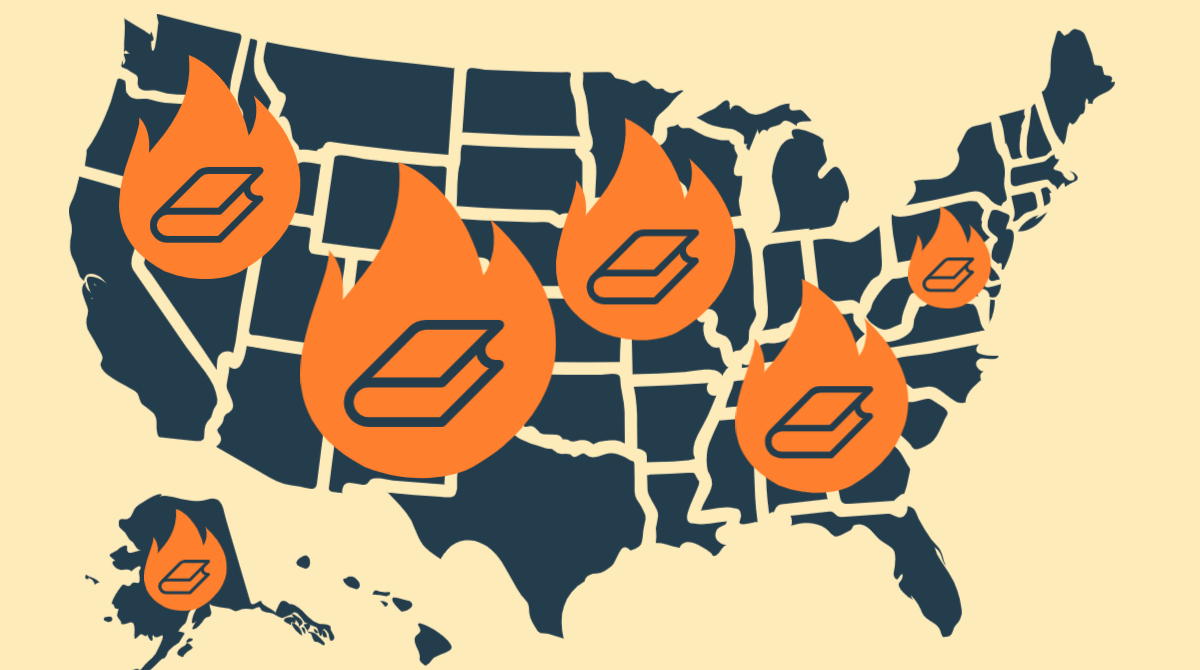
Libraries and schools across the country are experiencing unprecedented levels of attempts to ban or remove books from their shelves. I Love Libraries will continue to raise awareness by highlighting attempts to censor library materials, as well as efforts by librarians, parents, students, and concerned citizens to push back against them. This update includes news from Maryland, Florida, and Utah.
Become a Supporter
Maryland judge orders school board to put banned book back on library shelves
Lawmakers and educators have hailed a Maryland judge’s ruling reversing a county school board’s decision to pull a graphic novel from school system library shelves, after a panel of teachers and students had voted to keep it, reports Maryland Matters.
The ruling by Harford County Circuit Court Judge Yolanda Curtin was the first legal test of the state’s Freedom to Read Act, a 2024 law that sought to prevent the removal of materials from school libraries because of their authors’ backgrounds or because of “partisan, ideological or religious disapproval.” It upheld a 2025 decision by the state Board of Education that said the local board was wrong to remove the young-adult graphic novel “Flamer” from school libraries. Mike Curato’s semi-autobiographical novel follows a boy at camp the summer before he enters high school who struggles with his sexuality and his religion, bullying by other boys at camp, and thoughts of suicide.
Del. Dana Jones (D-Anne Arundel), the lead sponsor of the 2024 law, said the ruling shows the law is “doing exactly what it was intended to do: protecting our libraries, librarians, and the fundamental freedom to read.”
“When we passed this landmark law, we made a commitment that books would not be removed from our libraries simply because of partisan, ideological, or religious objections,” Jones said in a statement released. “Parents have every right to make decisions about what their own children read, but no single individual or school board should be able to make that decision for every family.”
Florida school district bans more than 250 more books
“Harriet the Spy” and “The Devil’s Arithmetic” were among 258 books that Escambia County (Fla.) School Board voted to remove from schools at a recent board meeting. The kicker: Most of the books hadn’t been challenged in Escambia schools, but were challenged in other local districts, reports Pensacola News Journal.
Twelve books, including “All’s Faire in Middle School,” “American Gods,” and “Eat, Pray, Love,” were challenged in Santa Rosa County District Schools. Book challenges also were listed from Clay, Nassau, Polk, St. Johns and St. Lucie County public schools as well. The list also included over 40 books that were challenged in Escambia County Public Schools but were not on the recommended Florida Department of Education State Objection Report.
Despite hearing mostly opposition to the blanket removal of the challenged books at the October 20 board meeting, several board members unanimously approved the measure without discussion.
One concerned citizen told board members she was opposed to the removal of books without local review.
“The state never required districts to remove these books. No one in Escambia County has challenged these books… It is my understanding that the new list of books to be banned is copied from a list of banned books in Clay County. I don’t live in Clay County. Why is Clay County deciding what students here are allowed to read?,” she asked board members.
Florida county pulls 1,800 library books for review
From classic novels like “The Scarlet Letter” to nonfiction works delving into sexual health, more than 1,800 titles have been flagged as part of a sweeping audit at a Florida School District reports WLRN.
The move comes after the Florida Department of Education issued a statewide memo urging districts to proactively review their libraries, removing books even before parents object to their content. The School District of Palm Beach County has since launched a monthslong audit that began with compiling an extensive list of potentially offending books, e-materials, and videos.
If a school media specialist has any of these works on their shelves, they must remove them from student access, review them, then write a signed attestation that justifies either keeping or removing them. They are also responsible for independently vetting their own libraries for any other titles that might fall foul of state regulations.
Advocates and former media specialists say these reviews are expensive and time-consuming, diverting resources from instructional time. But non-compliance, the memo explicitly stated, could lead to the withholding of state funding or make a district ineligible for competitive grants.
“It’s just an incredibly venal and vile attack on the right and the freedom to read,” said Mitch Kaplan, activist and founder of South Florida bookstore Books & Books. “And this is something that is just another step, a step further than what we’ve been seeing.”
Utah has banned 7 new books — at once — from all public schools in the state
Utah has banned seven more books from all public schools—the most it has ever banned in a single go since the state’s sensitive-materials law went into effect, reports the Salt Lake Tribune.
In Utah, the law requires that a book be removed from all public schools in the state if at least three school districts (or at least two districts and five charter schools) determine it amounts to “objective sensitive material” that meets state definitions for pornographic or otherwise indecent content. State officials typically do not cite the details of a book’s content when placing it on the statewide banned list.
The seven new titles were banned in late September after meeting the three-district threshold. None of the books were previously available in elementary schools. The additions bring the total number of books now banned in Utah public schools to 44.
The newly banned titles include:
- House of Earth and Blood,” by Sarah J. Maas (who already had six books on the statewide banned list).
- “Perfect,” by Ellen Hopkins (who already had four books on the statewide banned list).
- “Identical,” also by Ellen Hopkins.
- “Me and Earl and the Dying Girl,” by Jesse Andrews (who already had one book on the statewide banned list).
- “Kingdom of the Cursed” by Kerri Maniscalco.
- “Storm and Fury,” by Jennifer Armentrout.
- “The Invisible Life of Addie LaRue,” by V.E. Schwab.
Take action
Alarmed by the escalating attempts to censor books? Here are six steps you can take now to protect the freedom to read.
- Follow news and social media in your community and state to keep apprised of organizations working to censor library or school materials.
- Show up for library workers at school or library board meetings and speak as a library advocate and community stakeholder who supports a parent’s right to restrict reading materials for their own child but not for all
- Help provide a safety net for library professionals as they defend intellectual freedom in their communities by giving to the LeRoy C. Merritt Humanitarian Fund.
- Educate friends, neighbors, and family members about censorship and how it harms communities. Share information from Banned Books Week.
- Join the Unite Against Book Bans movement and visit our Fight Censorship page to learn what you can do to defend the freedom to read in your community
- Become a Supporter of the American Library Association and help ALA fight for libraries and everyone’s freedom to read.
Subscribe to the I Love Libraries newsletter! You’ll get news from the library world, advocacy updates, author interviews, book lists, and more delivered to your inbox every month.