The Libraries of Zelda: A Link Between Games
In case you haven’t heard, The Legend of Zelda: Tears of the Kingdom will be released globally on Nintendo Switch this Friday. Named the “Most Anticipated Game” at the 2022 Game Awards, the open-world adventure game is a sequel to the highly successful The Legend of Zelda: Breath of the Wild released in 2017.
Since the release of the first Zelda game in 1986, players have followed the series’ protagonist Link as he adventures to rescue Princess Zelda and save the kingdom of Hyrule from an array of villains and monsters. From complex puzzles to Link’s versatile arsenal of weapons and tools to familiar locations throughout Hyrule, the games often feature recurring items and places to rediscover between iterations. And that goes for libraries, too!
Just like in real life, libraries serve as essential places to complete main or side quests in the Zelda series. In one game, Link even becomes a kind of temporary librarian himself. Ahead of the release of Tears of the Kingdom, we’re diving into the past to explore some of the Zelda libraries and their critical role in helping Link save Hyrule.
A Link to the Past (Super Nintendo, 1991)
Nestled on a hill just south of Kakariko Village in A Link to the Past, the library-known as the House of Books-is unmistakable with its large and ornate symbol of a book and quill above its door. Atop one of the library’s six large bookcases sits a copy of the Book of Mudora, a collection and translation guide of ancient Hylian script and lore. The book, at first inaccessible, is essential for Link to advance in his quest to save Hyrule from the evil wizard Agahnim.
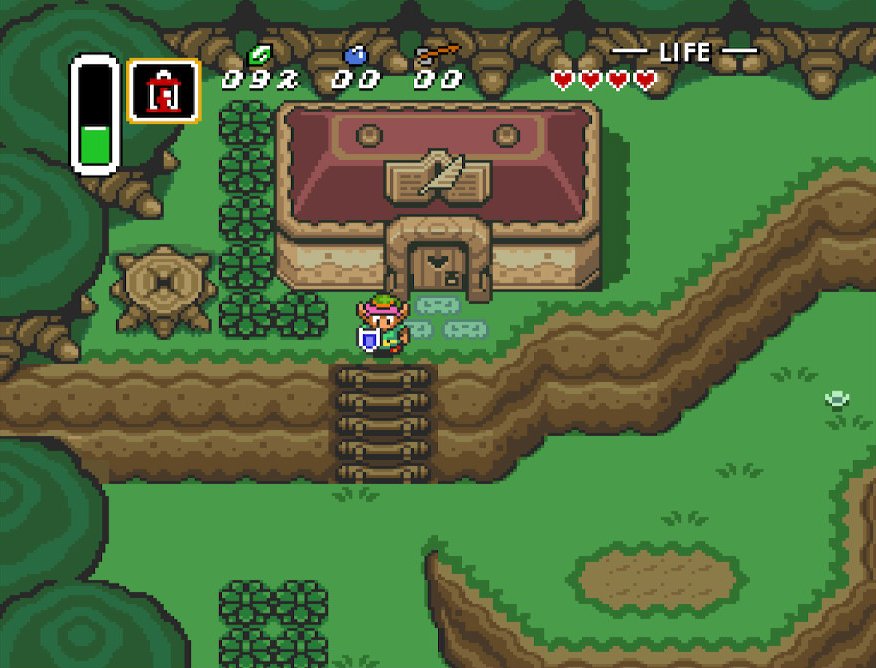
Link stands outside of the library in The Legend of Zelda: A Link to the Past. Screenshot by Chase Ollis/Nintendo.
After Link obtains the Pegasus Shoes and gains the ability to dash, he can ram into the bookcase to make the book fall to the floor and within reach. (Don’t try this at your local library!) With the Book of Mudora in hand, Link can enter the temple in the Desert of Mystery to obtain the Pendant of Wisdom, one of three pendants required to obtain the legendary Master Sword-the ultimate weapon of the Zelda franchise.
As they say, knowledge is power!
Link’s Awakening (Game Boy, 1993)
In Link’s Awakening, the player follows Link to a very different place on a very different adventure-simply to wake up. To do this, he must defeat the nightmares throughout Koholint Island and eventually use a collection of musical instruments to wake the giant sleeping Wind Fish found inside a colossal egg at the top of a mountain. It’s a harrowing task, and nearly impossible without the help of the Village Library!
The library lies southwest of the quaint Mabe Village, on the way to the island’s southern coast. Like many buildings on the island, the library is fairly small and nondescript on the outside. Two young boys throw a ball back and forth just outside its door as butterflies flutter around. But inside, there’s plenty to explore.
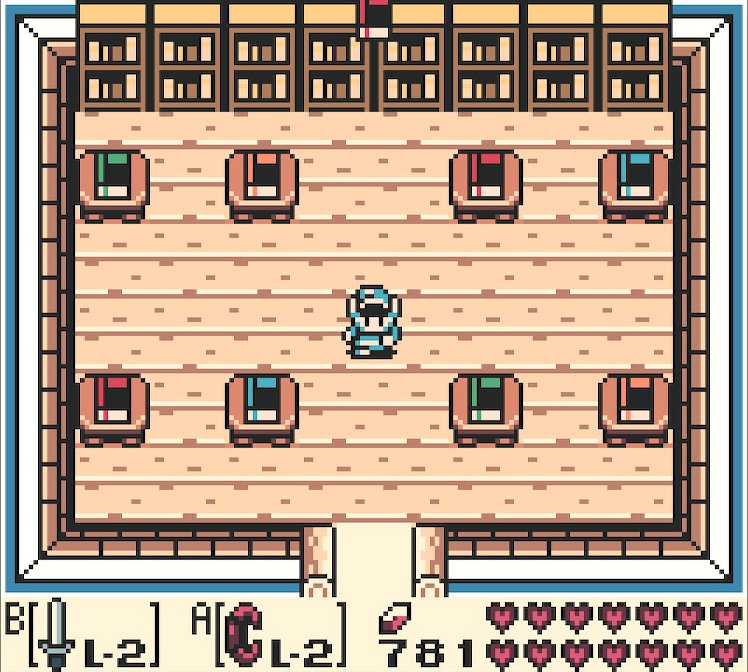
Link inside the Village Library in The Legend of Zelda: Link’s Awakening. Screenshot by Chase Ollis/Nintendo.
Several reference books rest on tables throughout the room. Many of these books detail basic gameplay functions: how to defend with your shield; use a warp hole to travel across the island; and assign items from your inventory. There’s also an atlas that shows a complete map of the island. But two other books are where the good stuff is.
After finding a magnifying lens inside a cave, Link is able to read the tiny print in Dark Secrets and Mysteries of Koholint, which contains unique directions for navigating the labyrinth within the Wind Fish’s egg. Without these directions, which vary between individual games, Link would wander aimlessly inside the ever-repeating corridors of the egg, possibly forever.
In the 1998 Game Boy Color rerelease of Link’s Awakening, a new book appears atop the library’s back shelves. Once again ramming into the shelves with the Pegasus Boots (again, don’t try this at your local library!), Link can read this book, which tells how to access the bonus Color Dungeon beneath the island’s graveyard. If Link completes this dungeon, he’s rewarded with a major boost of power and a fashionable new tunic.
Oracle of Ages (Game Boy Color, 2001)
In Oracle of Ages, Link must travel across time to save the Land of Labrynna and rescue Nayru, the Oracle of Ages, from the evil sorceress Veran. His quest brings him to Jabu-Jabu, a massive whale-like creature whose belly serves as one of the game’s dungeons. Unfortunately, filthy seawater has made Jabu-Jabu gravely ill, and Link is tasked to research the cause of the filthy seawater and find a way to cleanse it. What better place to conduct research than the local library!
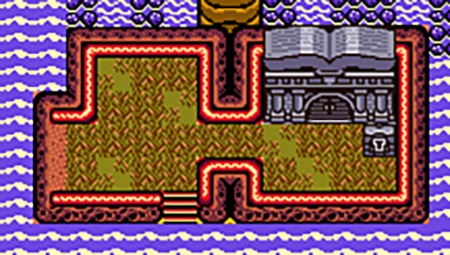
The library on Eyeglass Isle in The Legend of Zelda: Oracle of Ages. Via Zelda Wiki/Nintendo.
In both the past and the present, the ancient library on Eyeglass Isle is bustling with patrons. This is somewhat surprising, since it’s locked from the outside! After receiving the key, Link can enter the library, where he learns of the Fairy Queen who has been cursed by Veran, causing the filthy seawater. Traveling back and forth through time, Link can obtain the Book of Seals in the back room of the library in the past and use it to find fairy powder to lift the curse in the present, thus cleansing the sea and allowing Link to enter Jabu-Jabu’s belly.
Oracle of Ages is directly linked in plot to another game, Oracle of Seasons. In that game, Link will encounter the ghost of a former library worker, who will reveal a secret known only by the librarians of Eyeglass Isle Library. Back in Oracle of Ages, if Link tells the secret to the old man in the back room of the library, Link will receive the Mirror Shield, a powerful defensive weapon. Library secrets are the best secrets!
The Minish Cap (Game Boy Advance, 2004)
Navigating the world can be challenging at times, but what if you were the size of a thumb? That’s Link’s experience in The Minish Cap. In this game, our hero’s journey leads him to seek help from the Minish-tiny creatures that find joy in helping people and are only visible to children-so he can defeat the evil sorcerer Vaati. With the help of a Minish sage that he wears on his head like a cap, Link must frequently shrink to Minish size to complete numerous required quests, one of which brings him to the Royal Hyrule Library.
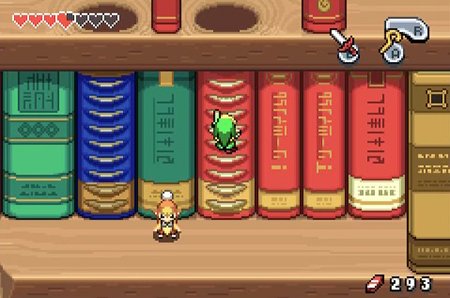
Link climbs up the spine of a book in the Royal Hyrule Library in The Legend of Zelda: The Minish Cap. Screenshot by Chase Ollis / Nintendo.
To advance in the story, Link must meet Librari, a Minish elder who lives among the library’s books on the second floor along with several other Minish. There’s only one problem: A few books are overdue and missing from the shelf, meaning there’s no way for Link to reach Librari. Our hero (and temporary volunteer librarian) must recover the overdue books from various locations around Hyrule.
After retrieving the books and returning them to the library’s circulation staff, the books are reshelved, and Link can climb them to meet Librari and ultimately obtain a pair of flippers. These flippers allow Link to swim in deep water and gain entrance to the Temple of Droplets in Lake Hylia. Completing this dungeon and finding the water element inside are essential for Link to craft the Four Sword-the weapon needed to defeat Vaati.
Breath of the Wild (Wii U and Nintendo Switch, 2017)
In the award-winning open world masterpiece Breath of the Wild, the land of Hyrule has been devastated by the Great Calamity, a cataclysmic event brought on by Calamity Ganon-a primal evil that has terrorized Hyrule throughout its history. Although Ganon was sealed inside Hyrule Castle by Princess Zelda, Link must defeat him before Ganon regains full strength and breaks free. Link’s quest takes him across a vast land to recruit powerful allies before venturing inside the malice-covered castle and its monster-infested library.
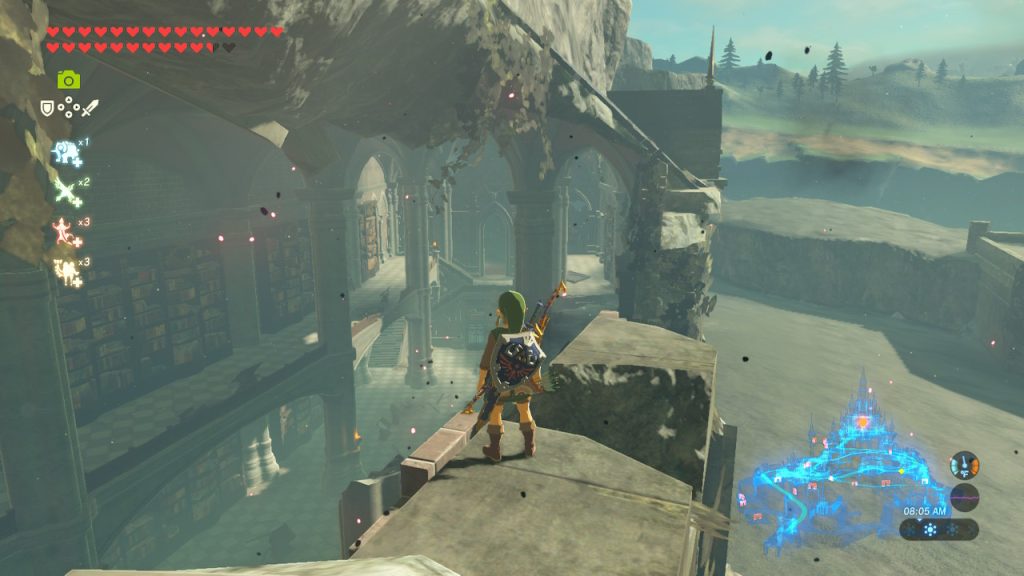
Part of the Hyrule Castle Library’s roof has collapsed after the Great Calamity in The Legend of Zelda: Breath of the Wild. Screenshot by Chase Ollis/Nintendo.
In another time, the library would be a wonder to behold. Giant stone columns and arches, enormous bookcases, and elegant reading tables and pedestals adorn the space. But following the Great Calamity, the library has fallen into disrepair and monsters roam both of its floors. (If only they were there to read!) Malice-a poisonous substance found throughout Hyrule that is the embodiment of Ganon-covers large areas of the floor and walls, and portions of the staircases and roof have crumbled. But beyond monsters and malice, the castle library is also filled with treasures, mysteries, and discoveries.
Players can explore several secret passageways behind the library’s bookcases leading to curious areas, including an excavation site outside of the observatory walls filled with treasure and powerful weapons; the King’s Study, where Link can learn more about Zelda’s background and the history of the Great Calamity; and the dock, a critical location under the castle that allows for quick passage.
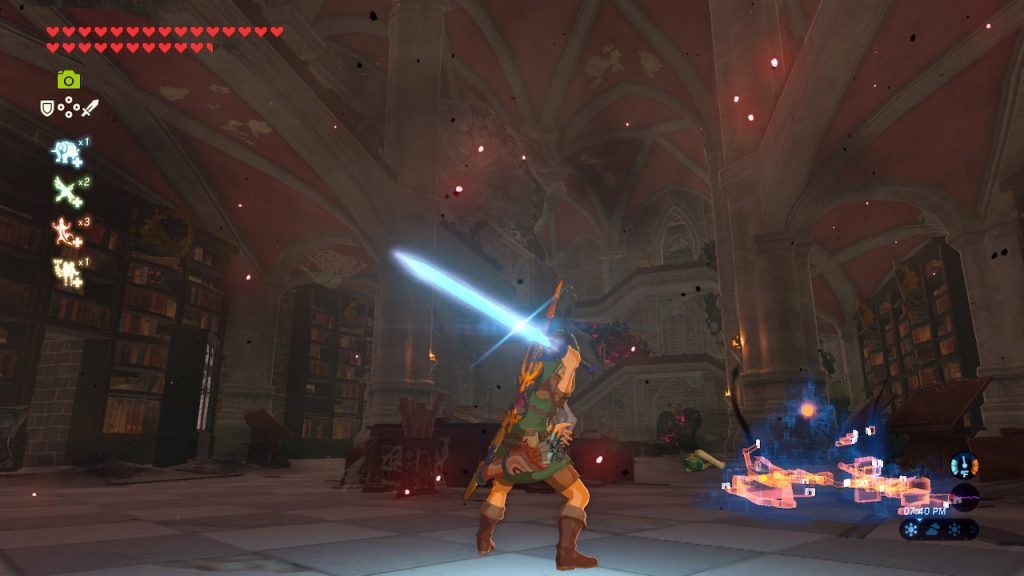
Link charges the Master Sword for battle in the Hyrule Castle Library in The Legend of Zelda: Breath of the Wild. Screenshot by Chase Ollis/Nintendo.
The library also holds two specific books that contain important recipes for the Royal Family of Hyrule, including Fruitcake and Monster Cake (which is actually a reference to a villain in another Zelda game). Finding these recipes allows Link to help Gotter, a stablehand and descendant of the castle’s appointed chef, to taste his ancestor’s food.
Perhaps most exciting about this game’s library, though, is its cataloging system. Books are organized by floor and then alphabetically by book title (in Hylian script, of course). One of the cookbooks is found on a reading pedestal across from a bookcase with titles that start with “C.” It’s a small detail in such an expansive game, but one that makes the spirit of the library-organization, access, and retrieval of information-truly come to life.
The Legend of Zelda: Tears of the Kingdom will be released Friday, May 12, 2023, and we’re hoping more library adventures come with it!
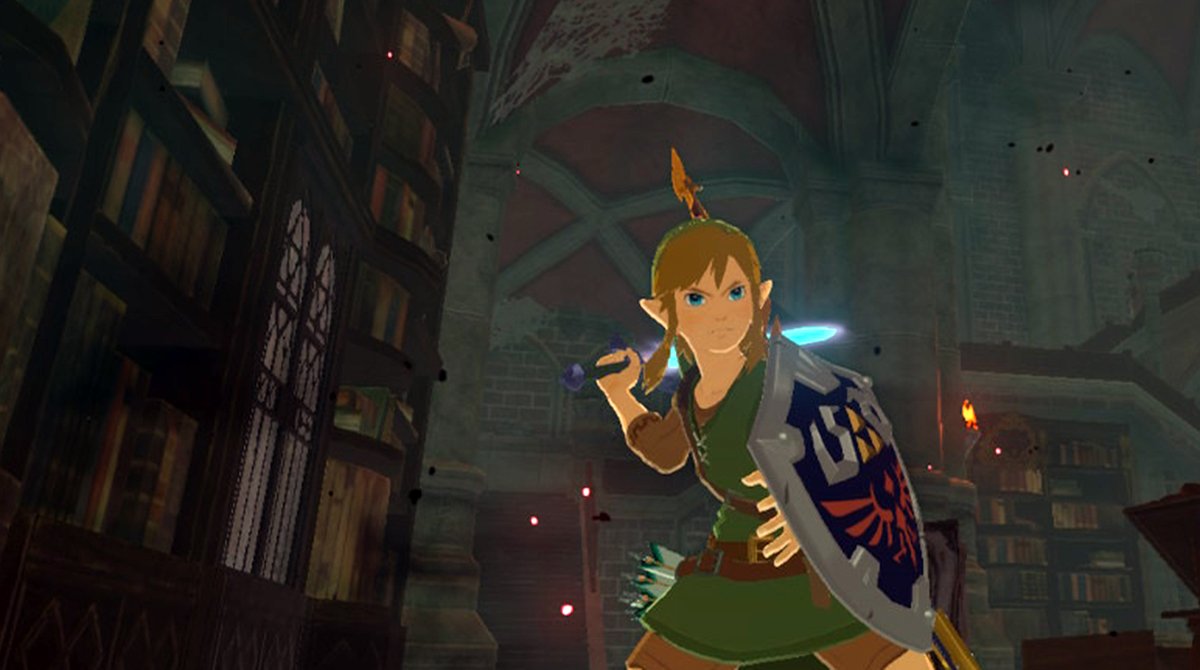
Feature photo: Link stands ready to battle in the Hyrule Castle Library in The Legend of Zelda: Breath of the Wild. Screenshot by Chase Ollis/Nintendo.


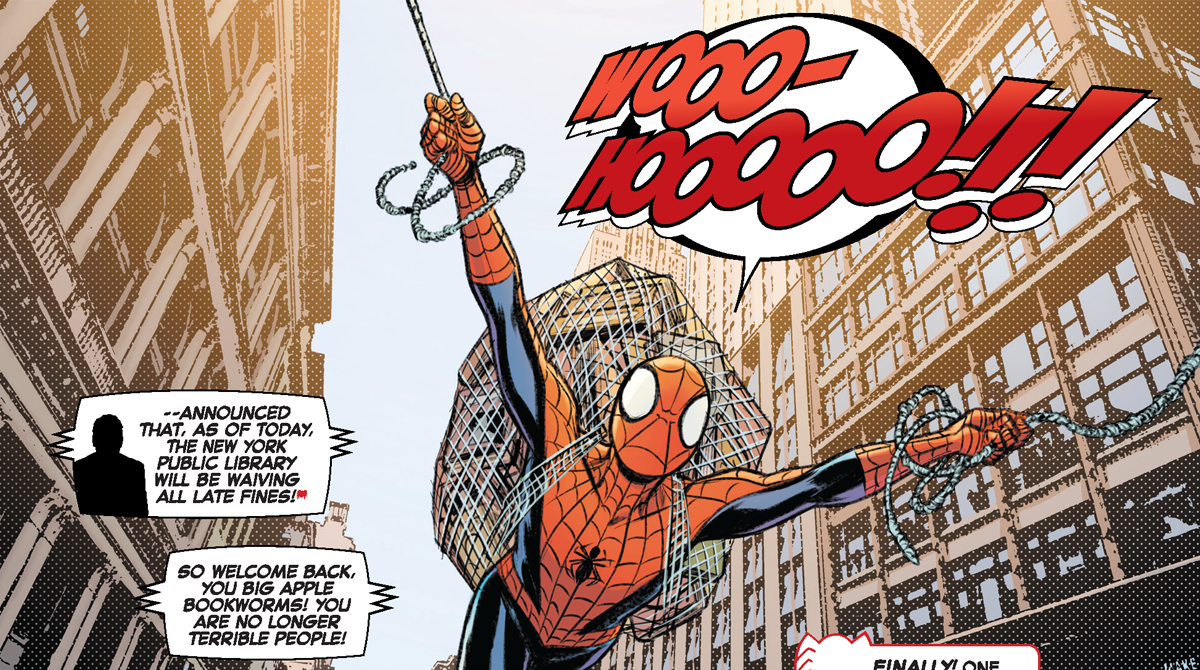
 Those with keen spidey senses may know this isn’t the webslinger’s first library adventure.