This Memorial Day, as the U.S. remembers those who died while serving in the U.S. Armed Forces, we’re reflecting on how the American Library Association (ALA) responded during World War I. As tragedy and despair spread across the world during those wartime years, ALA worked to brighten the spirits of wounded soldiers by providing them with books and reading materials. Leanna Barcelona at the ALA Archives explains.
During the course of U.S. involvement in World War I, ALA collected $5 million in donations for the Library War Service, a service that accumulated a collection of ten million publications and established thirty-six camp libraries across the United States and Europe. It was the ALA Library War Service’s mission to provide “a book for every man.”
The Library War Service accomplished a great deal in a short time. According to the June 1918 War Library Bulletin, there were 385,310 books shipped overseas. At that time, there were also 237 small military camps and posts equipped with book collections and 249 naval and marine stations and vessels supplied with libraries. The books were well-received by soldiers and sailors alike and unmistakably utilized widely. Vice-Admiral Albert Gleaves of the US Navy wrote:
“Do the sailors read very much? Do the soldiers read very much? I know from personal observation that the books were in constant demand, and that they were in constant circulation. They were placed as a rule near the troop compartments for the soldiers, and for the sailors they were placed in their compartments. The books were allotted to them and they would draw these books; they were not responsible in any way for their condition or what became of them. If the books were lost, that was profit and loss to the A. L. A., and didn’t concern the sailor man. There was no compulsion, no restraint; they had free access to these books.”
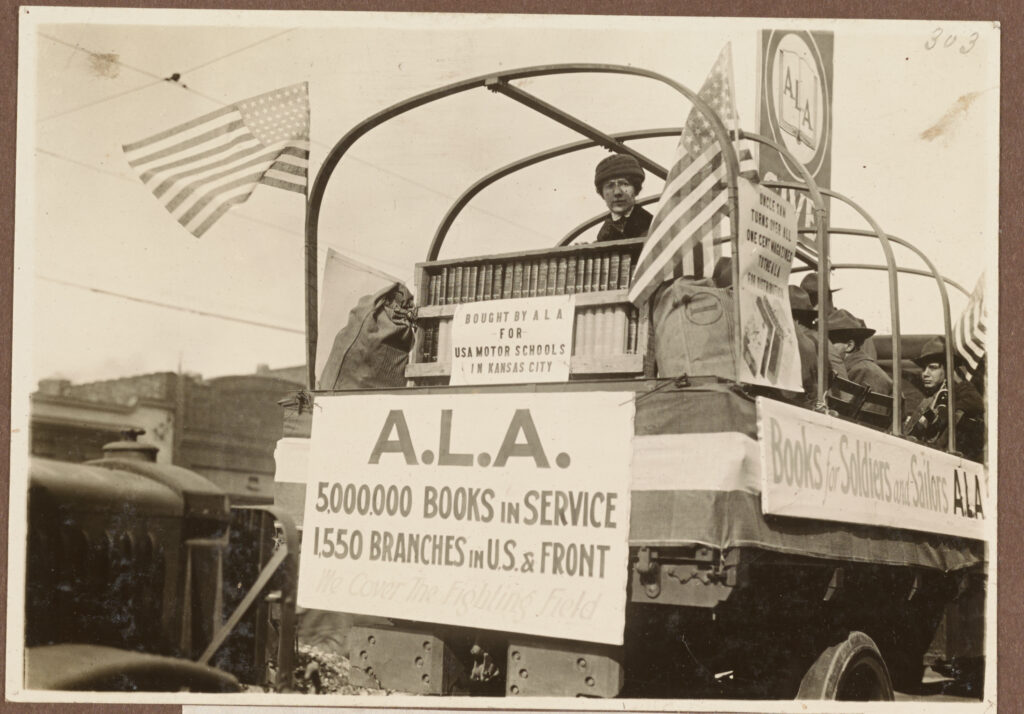
American Library Association parade float with servicemen riding inside for the United War Work Campaign; Kansas City, November 9, 1918, from the ALA Archives.
The previous year, Theodore Wesley Koch, Chief Order Division of the Library of Congress at that time, said in the Thirty-Ninth Annual Conference proceedings, “If anyone has a doubt as to whether these books and magazines are appreciated, a glance through the hundreds of letters kept at headquarters will dispel it.”
In the June 1918 War Library Bulletin, it was estimated that 2,100,000 gift books in service had been received and 411,505 books had been purchased. But what books were they providing for every man, and what were the soldiers and sailors most interested in reading?
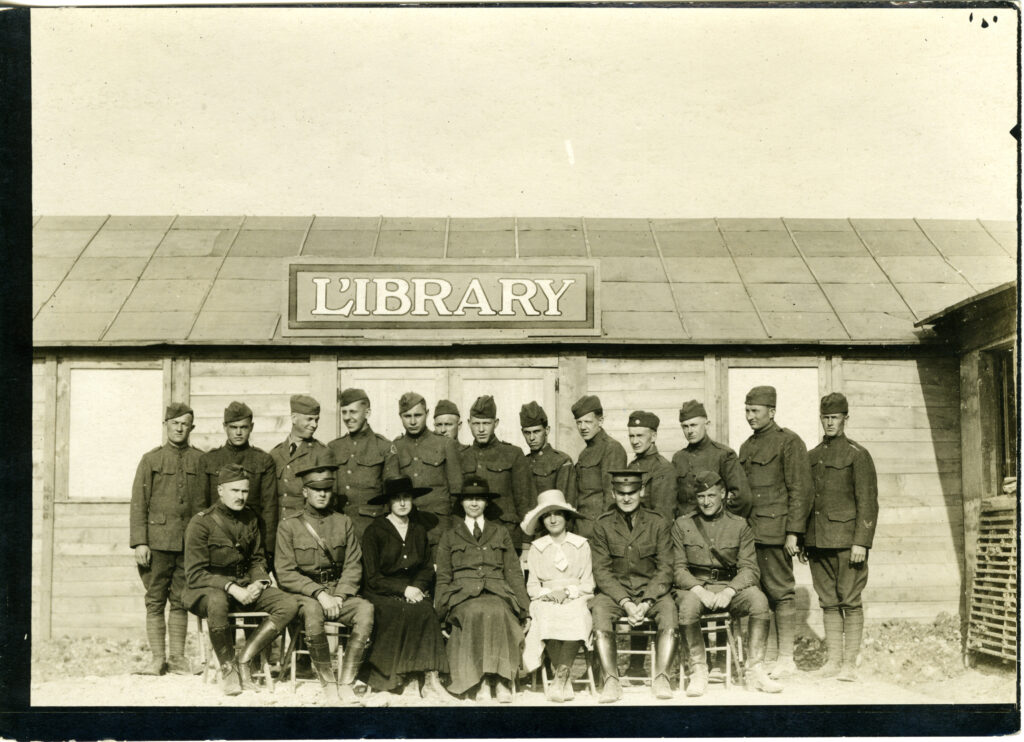
Servicemen and camp librarians in front of a American Library Association camp library in Le Mans, France. 1918. From the ALA Archives.
Of the 411,505 purchased by the Library War Service as of June 1918, most books were technical in nature. Reading was not always for pleasure, but rather a way for soldiers to pass the time until they returned home and needed a job. Passing the time wisely meant reading materials that would give them skills in various areas such as business, engines, plumbing and carpentry, and trains, in order to prepare them for jobs after the war. Vice-Admiral Albert Gleaves of the US Navy also spoke to this, stating:
“I think the enlisted man does not care so much nowadays about reading wild west stories as he does about something adequate to prepare himself for civil life when he leaves the service. Many of them have only one enlistment, but every man that goes out into the great body politic from the Navy, if he is the right sort of man, is better equipped than when he entered the service. So they want to prepare themselves for civil pursuits, and there has been a great demand, I understand from some of the officers of the Association, for technical books, on electricity, steam, boilers all that sort of thing.”
Although the Vice-Admiral did not think the soldiers were keen on reading for pleasure, Theodore Wesley Koch mentioned that, “The first and second sixpenny series of the ‘Hundred Best Poems’ go out in generous installments; so do the ‘Hundred Best Love Poems.’ Shakespeare is preferred in single plays…The officers ask for new six shilling novels and all kinds of lighter biographies, what Robert Louis Stevenson calls ‘heroic gossip’. Travel books of all sorts are acclaimed; so too, are the light-to-hold editions of Thackeray, Dickens, Poe, Kipling and Meredith.” Koch also mentioned that some libraries included games departments for soldiers, stating, “There is a never ceasing demand for playing-cards, dominos, draughts, and good jigsaw puzzles—even with a few pieces missing.”
Military men were also provided with materials related to warfare, in an effort to help win the war. M. S. Dudgeon, Camp Librarian in Great Lakes, Illinois, published an article in the Fortieth Annual Meeting Conference proceedings titled, “What Men Read in Camps,” and prefaced the article saying, “A man in camp reads books upon the subjects in which he is interested, just as you do, just as I do, just as any trained worker reads. Now, the one subject in which the man in the camp is most intensely interested is: winning this war, and as a result he is anxious to read anything that will help him lick the Kaiser.” Several of these books, however, were retracted from the libraries if they were deemed pacifist or in support of Bolshevism. In a letter dated to April 21, 1919, A. G. Hubbard, Assistant to the Director of the Library War Service, wrote to ALA Representatives and librarians with a list of books, “that should not be in the hands of impressionable young men. These titles were approved by the Book Department before bolshevism was such an apparent menace to the country.” Included in this list were titles such as Bessie Beatty’s “The Red Heart of Russia” and Leon Trotsky’s “The Bolsheviki and World Peace.”
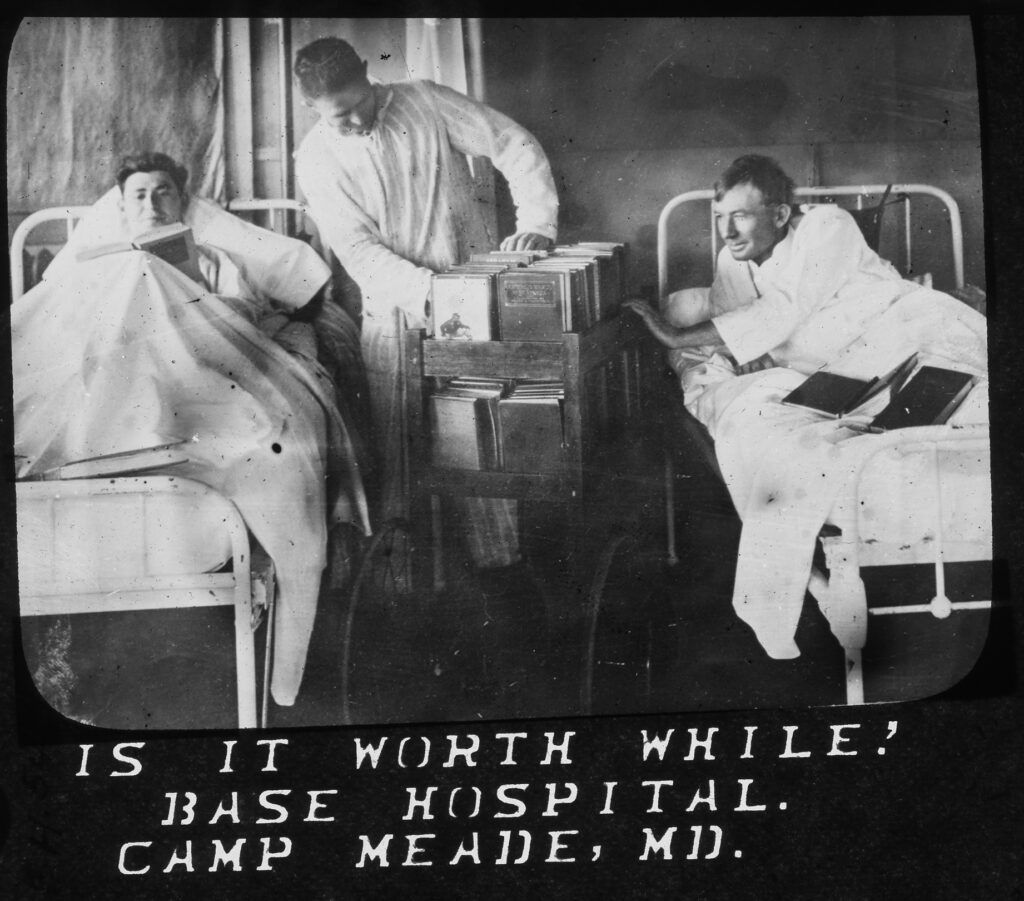
Glass plate slide showing convalescent soldiers perusing reading materials donated through the ALA's book drive during World War I, circa 1918. From the ALA Archives.
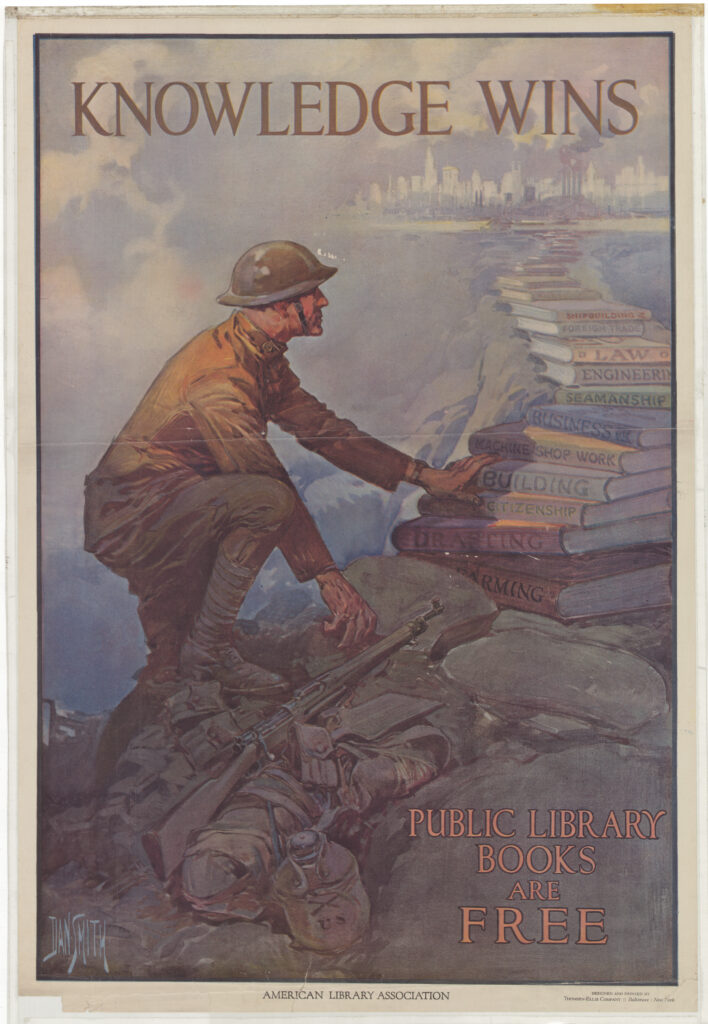
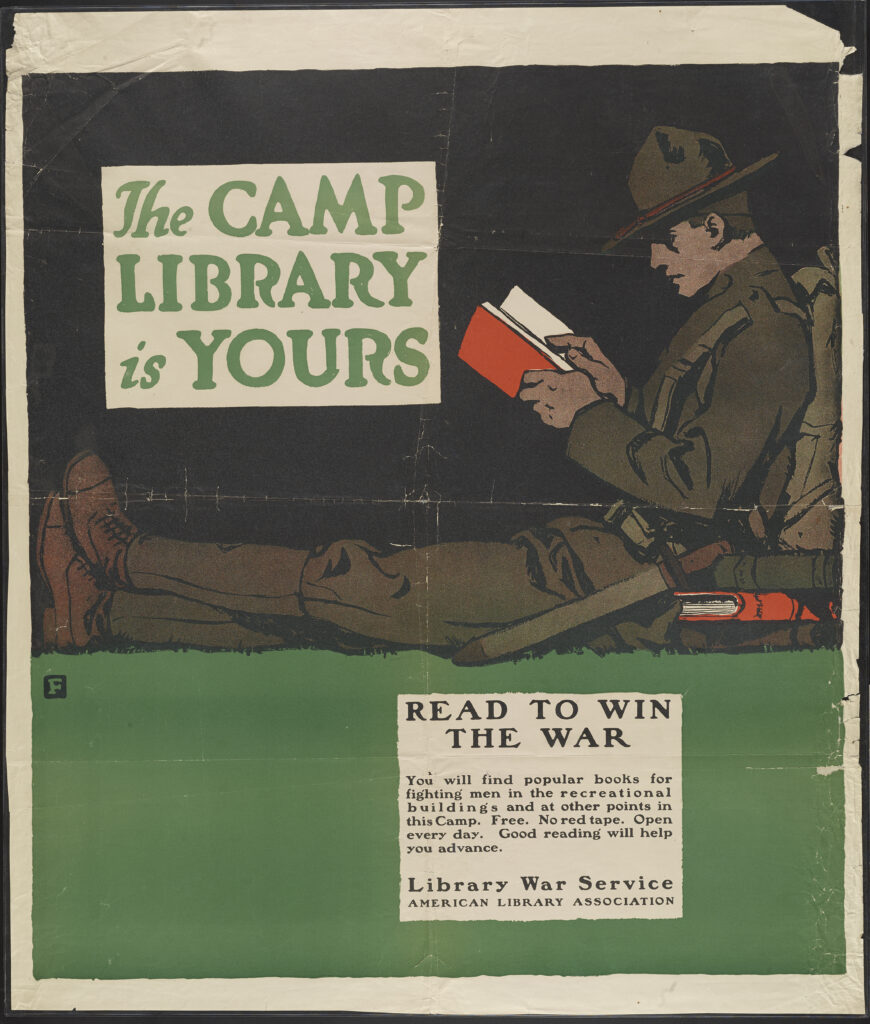
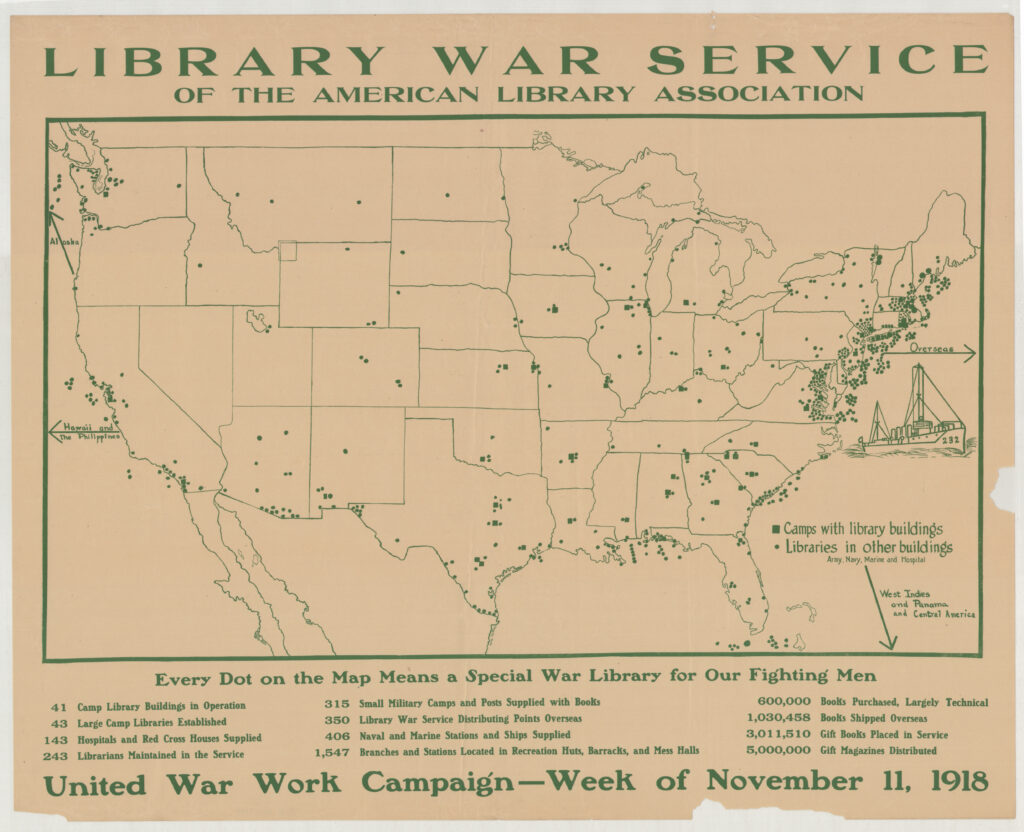
A selection of ALA Library War Service posters
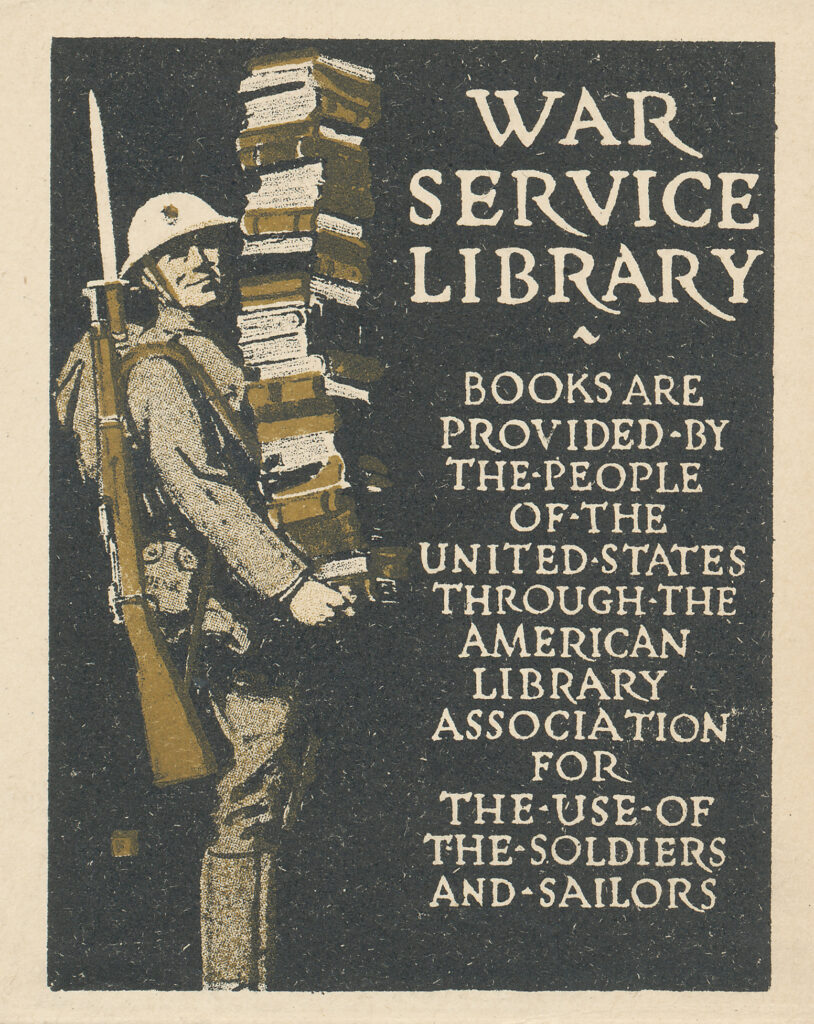
The bookplate used by the Library War Service during World War I in camp libraries, circa 1918. From the ALA Archives.
World War I poster with a soldier climbing a mountain of books. Dan Smith credited as artist and printed by Thomsen-Ellis Company (Baltimore, New York), circa 1918. From the ALA Archives.
World War I poster with a soldier sitting on the ground and reading, advertising camp library services, circa 1918. From the ALA Archives.
World War I poster with map of the United States with a dot for every war library, circa 1918. From the ALA Archives.
With library funding being gutted and censorship on the rise, supporting libraries is more critical than ever. If you’re looking for a way to help, we urge you to become a Supporter of the American Library Association by donating.
At the American Library Association, we are here to protect libraries — today and for generations to come. What does your donation do? It helps a neighbor gain skills to start a business. It helps a child discover themselves through books and programs. And it helps keep libraries strong, open, and free for everyone.
Become a Supporter
Help us fight back. Your donation powers our advocacy on behalf of libraries and library workers everywhere.
Subscribe to the I Love Libraries newsletter! You’ll get news from the library world, advocacy updates, author interviews, book lists, and more delivered to your inbox every month.
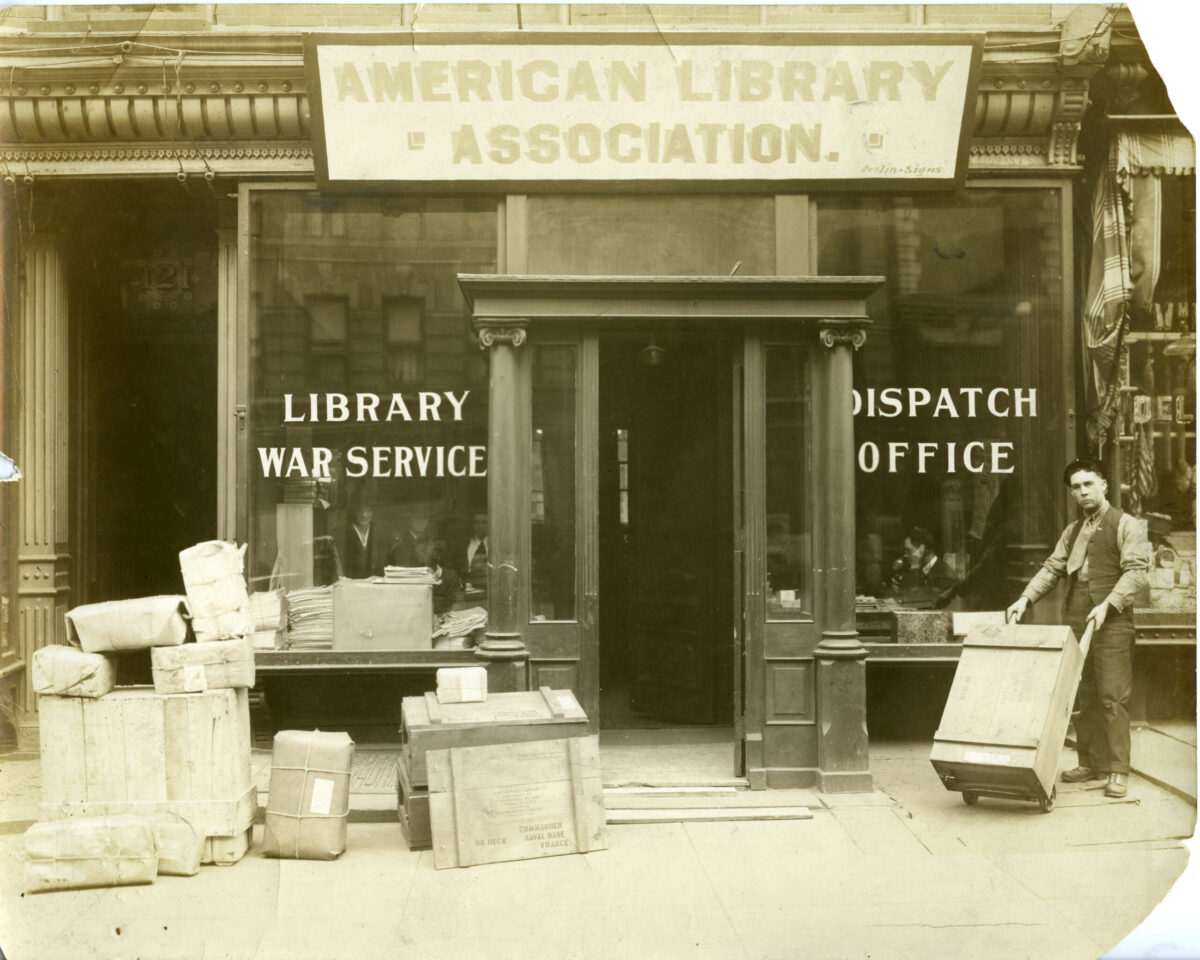
This story first appeared on the ALA Archives blog on March 20, 2017. Image: The exterior of the American Library Association dispatch office in Brooklyn, circa 1918. From the ALA Archives.
We use cookies on our website to give you the most relevant experience by remembering your preferences and repeat visits. By clicking “Accept All”, you consent to the use of ALL the cookies. However, you may visit "Cookie Settings" to provide a controlled consent.
This website uses cookies to improve your experience while you navigate through the website. Out of these, the cookies that are categorized as necessary are stored on your browser as they are essential for the working of basic functionalities of the website. We also use third-party cookies that help us analyze and understand how you use this website. These cookies will be stored in your browser only with your consent. You also have the option to opt-out of these cookies. But opting out of some of these cookies may affect your browsing experience.
Necessary cookies are absolutely essential for the website to function properly. These cookies ensure basic functionalities and security features of the website, anonymously.
Cookie
Duration
Description
cookielawinfo-checkbox-analytics
11 months
This cookie is set by GDPR Cookie Consent plugin. The cookie is used to store the user consent for the cookies in the category "Analytics".
cookielawinfo-checkbox-functional
11 months
The cookie is set by GDPR cookie consent to record the user consent for the cookies in the category "Functional".
cookielawinfo-checkbox-necessary
11 months
This cookie is set by GDPR Cookie Consent plugin. The cookies is used to store the user consent for the cookies in the category "Necessary".
cookielawinfo-checkbox-others
11 months
This cookie is set by GDPR Cookie Consent plugin. The cookie is used to store the user consent for the cookies in the category "Other.
cookielawinfo-checkbox-performance
11 months
This cookie is set by GDPR Cookie Consent plugin. The cookie is used to store the user consent for the cookies in the category "Performance".
viewed_cookie_policy
11 months
The cookie is set by the GDPR Cookie Consent plugin and is used to store whether or not user has consented to the use of cookies. It does not store any personal data.
Functional cookies help to perform certain functionalities like sharing the content of the website on social media platforms, collect feedbacks, and other third-party features.
Performance cookies are used to understand and analyze the key performance indexes of the website which helps in delivering a better user experience for the visitors.
Analytical cookies are used to understand how visitors interact with the website. These cookies help provide information on metrics the number of visitors, bounce rate, traffic source, etc.
Advertisement cookies are used to provide visitors with relevant ads and marketing campaigns. These cookies track visitors across websites and collect information to provide customized ads.