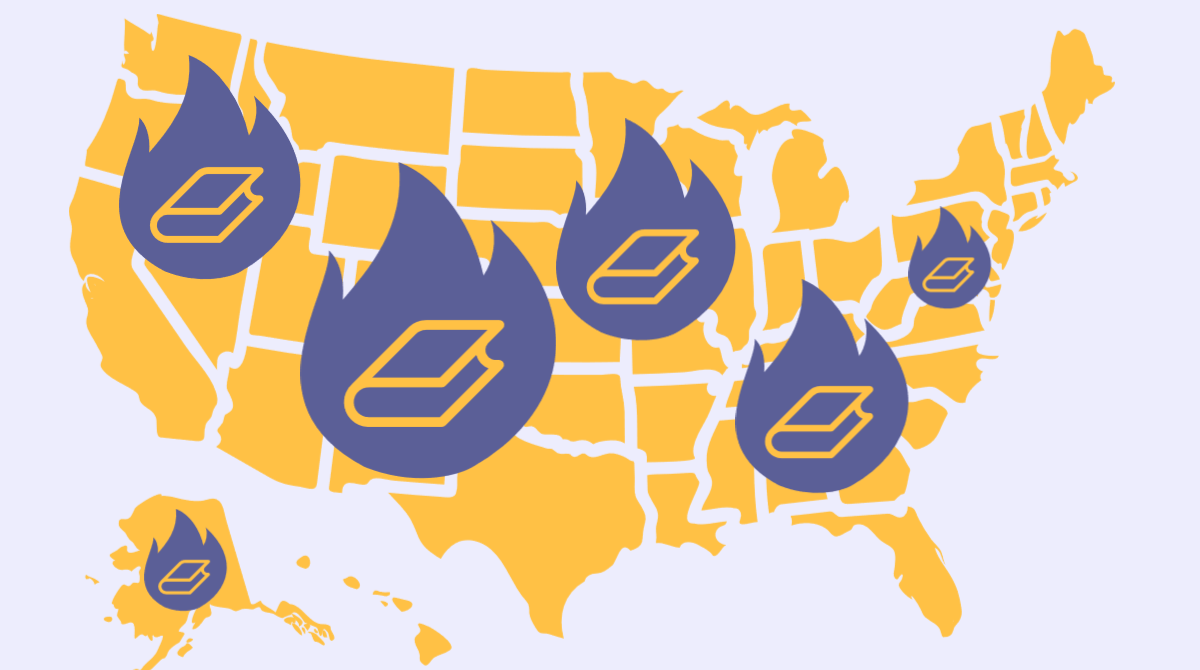
Libraries and schools across the country are experiencing unprecedented levels of attempts to ban or remove books from their shelves. I Love Libraries will continue to raise awareness by highlighting attempts to censor library materials, as well as efforts by librarians, parents, students, and concerned citizens to push back against them. This update includes news from Tennessee, Florida, and North Carolina, as well as a look at U.S. House and Senate legislation that could nationalize book bans.
Become a Supporter
Lawsuit claims Tennessee county library book bans are unconstitutional and politically motivated
Anderson County (Tenn.) Library Alliance, a nonprofit library advocate group, and two members of the community are suing the county and its library board, claiming the county’s recent talk of book banning is a thinly-veiled attempt to forward President Trump’s conservative agenda and violates the Constitution, reports WVLT 8.
The lawsuit stems from a letter Tennessee Sec. of State Tre Hargett sent to almost every library system in the state. He ordered library staff to begin reviewing books in children’s sections that could violate Trump’s executive order calling for “inappropriate” material to be taken from public spaces children could access. That directive, Hargett claimed, was in line with Tennessee’s own Age Appropriate Materials Act, which limits how school systems stock libraries children can access.
The lawsuit claims that limiting public access to books violates the First Amendment.
“These mechanisms while not as unhinged as a book ban, still cannot remove the stench of government regulation violative of the First Amendment of the United States Constitution,” the lawsuit reads.
The lawsuit also attacks Hargett’s letter, and even Trump’s executive order, directly. It says the secretary of state cannot use the Age Appropriate Materials Act to justify libraries limiting book access, because the act applies only to school systems. As for the executive order, the lawsuit points to the civics process, arguing an executive order can’t dictate state policy.
What comes after book bans? A Florida school district questions traditional libraries
A Florida school district that has already removed hundreds of books is questioning whether traditional high school libraries are needed, reports WUSF NPR.
At a recent workshop, a Clay County School Board member said it would be helpful to talk to school employees about what “they see as the benefits of the media center…. What would be a high-level function for that space in their school?” they asked.
A chief academic officer floated them as research centers and more: “School stores make sense,” he said and added that high school students especially are checking out books at a low rate.
“We’re spending a lot of resources on a problem that I acknowledge exists, and at the same time, kids aren’t actually reading the books at all, they’re not reading the good ones either,” he said.
Clay County District Schools has already removed classics like “The Handmaid’s Tale,” “Slaughterhouse-Five,” and “The Color Purple” from its schools. A majority of the challenges have come from a single conservative activist.
Clay County School District said in a statement that the conversations were part of an exploratory workshop looking to modernize learning environments.
New law tucked into North Carolina budget mandates statewide process for book challenges
A new state law in North Carolina requires every public school district to create an 11-member Community Media Advisory Committee made up of three principals, three teachers, three school library media coordinators and two parents, reports CBS17.
Anyone can file a written challenge claiming a book is obscene or inappropriate for a student’s age or maturity level, or that classroom materials are not aligned with the state’s curriculum. Once a written challenge is submitted, the committee must hold a hearing within two weeks and then make a recommendation to the school board, which would have the final say.
Laurie Monroe, a middle school librarian and president of the North Carolina School Library Media Association Monroe said that the timeline is simply not practical.
“It feels like a really fast turnaround to get those people together, to get them having read the book and to get them through the process,” she said.
She also questioned whether the law is even needed, saying it creates a cumbersome process that many districts already have.
“This is redundancy; districts and schools already have this in place,” she said. “It feels like an extra barrier. Is it really any different than what’s already there? You’re just asking more principals and teachers and librarians to be involved at the expense of time.”
Republican senators introduce nationwide book ban bill
There are currently three bills in Congress that would permit widespread book censorship nationwide, reports Book Riot. All three originated from the House of Representatives. They are as follows:
HR 7661, also known as the “Stop the Sexualization of Children Act,” would modify the Elementary and Secondary Education Act of 1965 by prohibiting the use of funds under the act “to develop, implement, facilitate, host, or promote any program or activity for, or to provide or promote literature or other materials to, children under the age of 18 that includes sexually oriented material, and for other purposes.”
HR 2616, a nationwide “don’t say trans” bill, would require that any school receiving federal funds under the Elementary and Secondary Education Act of 1965 require parental permission before using a student’s preferred gender, pronouns, or name on any school form or allowing them to use the bathroom or locker room that most aligns with their identity. The bill also prohibits teaching “gender ideology” in public schools receiving federal funding, as defined in Trump’s Executive Order 14168.
HR 8705, dubbed “The CHARLIE Act,” is an amalgam of the previous two bills and would withhold funding from public schools that teach inclusivity, especially when it relates to race and gender.
Senate Republicans have also developed their own similar legislation. In late June, Republicans in the Senate introduced S. 4925, also called the “Stop the Sexualization of Children Act,” which mirrors the language in HR 7661. S. 4925 would “prohibit funding for sexually oriented material” in public schools across the country with some exceptions for “standard science coursework, including biology, botany, zoology, microbiology, cytology, genetics, ecology, human health, or human anatomy and physiology; the texts of major world religions; classic works of literature; or classic works of art.”
Take action
Alarmed by the escalating attempts to censor books? Here are six steps you can take now to protect the freedom to read.
- Follow news and social media in your community and state to keep apprised of organizations working to censor library or school materials.
- Show up for library workers at school or library board meetings and speak as a library advocate and community stakeholder who supports a parent’s right to restrict reading materials for their own child but not for all
- Help provide a safety net for library professionals as they defend intellectual freedom in their communities by giving to the LeRoy C. Merritt Humanitarian Fund.
- Educate friends, neighbors, and family members about censorship and how it harms communities. Share information from Banned Books Week.
- Join the Unite Against Book Bans movement and visit our Fight Censorship page to learn what you can do to defend the freedom to read in your community
- Become a Supporter of the American Library Association and help ALA fight for libraries and everyone’s freedom to read.
Subscribe to the I Love Libraries newsletter! You’ll get news from the library world, advocacy updates, author interviews, book lists, and more delivered to your inbox every month.