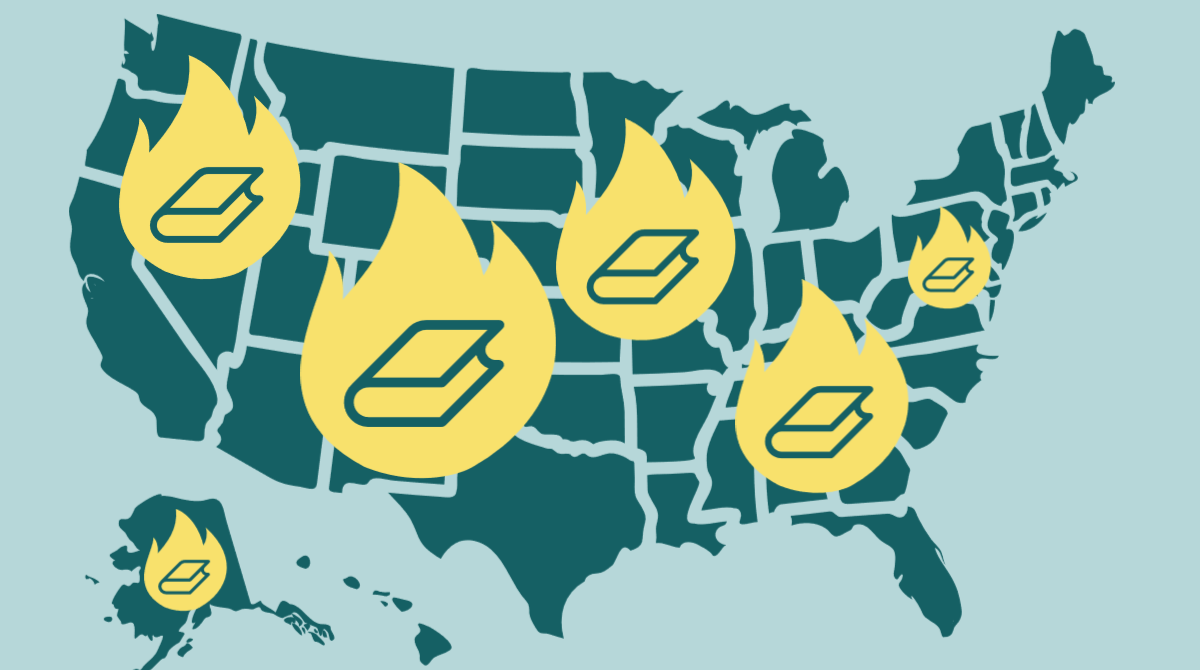
Libraries and schools across the country are experiencing unprecedented levels of attempts to ban or remove books from their shelves. I Love Libraries will continue to raise awareness by highlighting attempts to censor library materials, as well as efforts by librarians, parents, students, and concerned citizens to push back against them. This update includes news from Utah, Texas, and Ohio.
Become a Supporter
Utah begins 2026 by banning three books at all public school stateside
Utah officials started the year by banning three more books in public schools across the state, reports Kelly Jensen for Book Riot. “Wicked: The Life and Times of the Wicked Witch of the West” by Gregory Maguire, “Nineteen Minutes” by Jodi Picoult, and “The Perks of Being a Wallflower by Stephen Chbosky” join 19 other titles on a state-sanctioned ban list and must now be removed from all schools. These removals put Utah at the top of states with the most banned books, beating out South Carolina’s 21 bans.
In 2024, Utah passed House Bill 29 (HB 29) one of the strictest bills related to books in public schools in 2024. HB 29 allows parents to challenge books they deem “sensitive material,” and it also bans books from all public schools in the state if those books have been deemed “objective sensitive material” or “pornographic” per state code in at least three public school districts or two public school districts and five charter schools statewide. The bill went into effect July 1, 2024, and it started with 13 titles on it. The bill is retroactive, meaning that titles which met the state’s guidelines prior to the bill’s start date were included on the list.
“We’re going to continue to see more books added to this list in Utah as the school year carries on,” writes Jensen. “These are not, of course, the only books being banned in the state where book bans are happening, despite claims by the federal Department of Education. Individual school districts are allowed to ban any books they deem inappropriate–which, of course, helps add more titles to the state list as only three districts need to remove a book before the book must be removed everywhere.”
Bestselling authors sue Utah officials over book bans
A group of bestselling authors whose books have been banned from Utah public schools are suing state officials, arguing that Utah’s sensitive materials law is unconstitutional, reports the Carmen Nesbitt for the Salt Lake Tribune. Among the plaintiffs are award-winning novelists Elana K. Arnold and Ellen Hopkins, whose books make up five of the 22 titles that have been banned from all Utah public schools.
“We do not live in a world where no one experiences sexual assault, gaslighting or abuse,” Arnold says in the lawsuit, referring to subjects in her books “What Girls Are Made Of” and “Damsel.” Both have been removed from schools across the state.
“These issues are real concerns for teens today and pretending otherwise does them a disservice,” Arnold continued. “Teen girls do not need us to protect them from the truths of our world.”
Kurt Vonnegut’s estate, represented by the late author’s four children, is also a plaintiff in the new federal lawsuit, which in addition to state officials names as defendants a handful of individual school districts that have separately banned books not currently prohibited statewide.
Vonnegut’s 1969 novel “Slaughterhouse-Five” was removed from the Washington County School District in 2023 after its content was deemed “pornographic,” according to the lawsuit.
“Utah’s lawmakers’ determination to ban books like ‘Slaughterhouse-Five’ denies innumerable young people in Utah the freedom to read, think and grow,” Nanette Vonnegut, daughter of Kurt Vonnegut, said in a Tuesday news release. “It is antithetical to what my father fought for during World War II and focused much of his literary legacy on addressing.”
Texas district cancels author visit over parent complaints
Alamo Heights (Texas) Independent School District (ISD) parents are voicing anger after the district canceled a visit by a children’s author whose nonfiction book about the history of glitter and plastic was deemed too radical under Texas’ anti-DEI law, reports Michael Karlis for the San Antonio Current.
Writer Chris Barton was invited to speak to 1,600 students at Alamo Heights ISD’s Cambridge and Woodbridge elementary schools this month, but the visit was canceled after three parents complained about his book, “Glitter Everywhere! Where It Came From, Where It’s Found & Where It’s Going,” which gives a detailed history of the origins of glitter, the science behind it, and the environmental impact of microplastics.
One sentence in the 52-page book triggered concern. The sentence is found on page 33, where Barton writes “to signal the welcoming of LGBTQ+ worshippers, some congregations now offer a mix of ashes and purple glitter.”
The cancelation is just the latest disruption prompted by Texas Senate Bill 12, which bars all programs and activities that mention race, ethnicity, gender identity, or sexual orientation in K-12 public schools in Texas, including charter schools.
Ohio business gives access to banned books with monthly subscription service
A small business in Ohio is providing access to banned and challenged books via the mail, reports Rose Todd for Spectrum 21 News.
Banned Books Box is a monthly subscription service that sends two banned books a month to its subscribers. Owner Ariel Hakim started Banned Books Box in 2021 after she started learning about book bans. The service currently has around 250 monthly subscribers.
Ohio does not have an official statewide ban on books in place, but that has not deterred Hakim. She is on a mission to share banned books and remind people about the importance of the freedom to read and access to information.
“I want people to read books that are being banned so that they can you can read for [themselves] and decide, is this book inappropriate,” said Hakim.
Limiting access to books also stifles representation, Haim notes.
“Banning books takes away the opportunity for people to see themselves in books and from marginalized, already marginalized groups to really be able to tell their stories and for others to listen to those stories,” she said.
Banned Books Box subscriber Lisa Vahey has had the subscription service since 2022 and has received more than 40 books. She told Todd she’s always been an avid reader and thinks that books are a part of experiencing the lives of other people around us.
“When people’s stories are being silenced, we can take action,” Vahey said. “We can do something to fight back.”
Take action
Alarmed by the escalating attempts to censor books? Here are six steps you can take now to protect the freedom to read.
- Follow news and social media in your community and state to keep apprised of organizations working to censor library or school materials.
- Show up for library workers at school or library board meetings and speak as a library advocate and community stakeholder who supports a parent’s right to restrict reading materials for their own child but not for all
- Help provide a safety net for library professionals as they defend intellectual freedom in their communities by giving to the LeRoy C. Merritt Humanitarian Fund.
- Educate friends, neighbors, and family members about censorship and how it harms communities. Share information from Banned Books Week.
- Join the Unite Against Book Bans movement and visit our Fight Censorship page to learn what you can do to defend the freedom to read in your community
- Become a Supporter of the American Library Association and help ALA fight for libraries and everyone’s freedom to read.
Subscribe to the I Love Libraries newsletter! You’ll get news from the library world, advocacy updates, author interviews, book lists, and more delivered to your inbox every month.