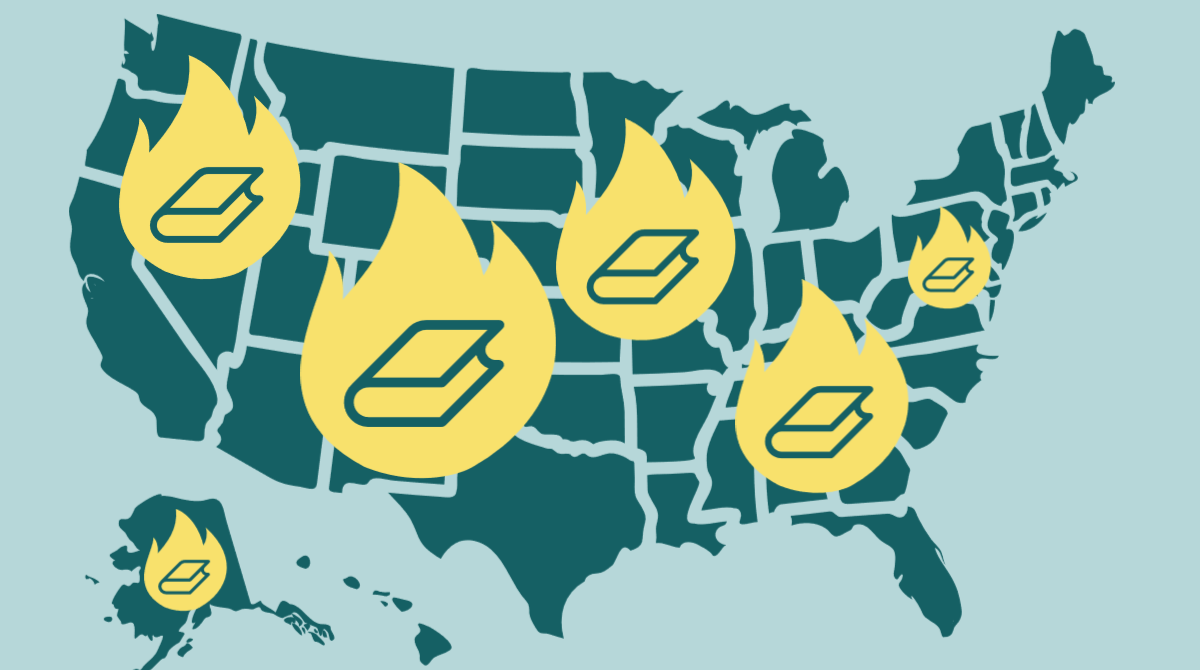
Libraries and schools across the country are experiencing unprecedented levels of attempts to ban or remove books from their shelves. I Love Libraries will continue to raise awareness by highlighting attempts to censor library materials, as well as efforts by librarians, parents, students, and concerned citizens to push back against them. This report includes news from Florida, Michigan, South Carolina, and Maryland.
Become a Supporter
Federal judge overturns large part of Florida’s book ban law
A federal judge has overturned most of Florida’s book ban law, reports Central Florida Public Media.
The judge found that the state’s law, HB 1069, goes against students’ First Amendment rights. He also said more than 20 books on a list of titles challenged in Florida are not obscene.
The list of books the judge ruled should not have been removed from Florida schools and are not obscene include classics like “The Color Purple” by Alice Walker, “Slaughterhouse-Five” by Kurt Vonnegut, “The Handmaid’s Tale” by Margaret Atwood, “The Bluest Eye” by Toni Morrison, and “Looking for Alaska” by John Green.
The ruling is a huge win for Florida schools, parents, and kids, said Florida Freedom to Read Project’s Director Stephana Ferrell.
“The judge affirmed that students have a right to access information and that authors have a right to have their books reach their intended audience without viewpoint-based limitations placed on that access,” Ferrell said.
Ferrell said the ruling makes it easier for parents and students to sue if certain books are removed from schools and school libraries.
“It is quite important that 23 books were named, that the judge says these books are not obscene, and that the restrictions are unconstitutional. That is important, and that does give parents and students the right to pursue litigation,” said Ferrell.
Michigan judge denies request to toss school librarian’s lawsuit against Moms for Liberty member
A Michigan librarian’s case against a member of the far-right group Moms for Liberty will proceed following a judge’s decision to deny a request for summary disposition, reports Michigan Advance.
Christine Beachler, library media director for Lowell Area Schools in May filed a civil suit against Moms for Liberty associate Stefanie Boone, hitting back against what she described as a “smear campaign” including name calling, harassment, and a flood of false statements posted to Facebook, including allegations that she is providing pornography to minors.
Moms for Liberty advocates against school curriculums that include discussions of LGBTQ+ identities and discussions of race and racism. The group has also advocated for bans on racially inclusive books and books with LGBTQ+ content or themes.
Boone and her attorney filed a motion to have the case dismissed without a trial, but Judge Christina Mims denied that request on August 1.
Beachler’s attorney, Elizabeth Geary, said they were happy with the judge’s ruling.
“We are pleased that the court saw through Defendants’ self-promoting attacks on libraries and librarians and rejected the motion to get out from under this case,” Geary said. “We look forward to moving forward in discovery and demonstrating the harm that Defendants’ campaign against Christine has caused.”
South Carolina school board restricts 9 books for first time under state regulation
Beaufort County (S.C.) Board of Education voted August 22 to restrict nine books in district classrooms, reports The Island Packet.
This is the first time the board has acted on book complaints under a South Carolina regulation instead of referring challenges directly to the state board. The move marks a turning point for schools across South Carolina, as many books challenged and banned at the state level originated from complaints by a single Beaufort County parent.
The decision followed a July 18 letter—obtained by The Island Packet and Beaufort Gazette through a public records request—in which the state board asked the district to handle new book complaints internally rather than forwarding them immediately. Under Regulation 43-170, school districts must publicly review and vote on any complaints about instructional materials, including classroom and library books, that contain descriptions or images of sexual conduct. Parents or legal guardians may submit up to five complaints per month if they have made a good-faith effort to resolve their concerns with school or district staff.
At least 14 of the 22 books banned or restricted in South Carolina thus far this year were challenged by one person. The person in question no longer has a student in the district. However, her earlier complaints continue to be reviewed because they were validly filed while her child was enrolled, and the state board has directed the local board to address them.
Community members, including students, parents and members of Families Against Book Bans (FABB), spoke out against restricting the books at the August 22 board meeting. The complainant was also present and read passages she deemed inappropriate.
The board ultimately chose to restrict the nine books rather than ban them. The restricted books will remain in school libraries, but students may access them only with parental consent.
Following the vote, FABB released a statement saying they were grateful to the community and board members who spoke against removing books but were disappointed the majority of the board did not follow community review committee recommendations.
“While these nine titles will remain on shelves, we also recognize that restricted access is a form of censorship,” the FABB press release said.
The nine restricted books include “The Bluest Eye,” “The Kite Runner” by Khaled Hosseini, “The Lovely Bones” by Alice Sebold, and “Thirteen Reasons Why” by Jay Asher.
Maryland community members protest school district’s ban of graphic novel
On August 18, community members in Harford County, Maryland, protested the local school board’s decision to ban the illustrated novel “Flamer,” by Mike Curato, from its libraries, reports WJZ CBS Baltimore.
“Flamer” is about a teenage boy who “navigates friendships, deals with bullies, and spends time with Elias (a boy he can’t stop thinking about) [and] finds himself on a path of self-discovery and acceptance,” according to the author. Members of the advocacy group “Together We Will Harford County” organized the protest after the school board voted to ban the graphic novel from school libraries in June
“I feel that the school board is buckling under political pressure from a small group of citizens that have an agenda,” said one protester.
“Flamer” was not on the agenda for the board meeting, but people who oppose the decision as well as people who support it spoke during the school board meeting’s public comment. The book was previously approved by district committees. However, after an appeal from a parent, the board voted in June to remove it, making it the first book pulled under a new review policy.
Protesters say the book ban threatens students’ rights.
“In the school system, parents can opt out of any book that they want for their child,” said Delane Lewis, president of Together We Will. “There is already plenty of support or protection for any parent who doesn’t want their child to read a book. What we have is the Board of Education stepping in front of parents and telling them what they should or shouldn’t have their children read.”
Take action
Alarmed by the escalating attempts to censor books? Here are six steps you can take now to protect the freedom to read.
- Follow news and social media in your community and state to keep apprised of organizations working to censor library or school materials.
- Show up for library workers at school or library board meetings and speak as a library advocate and community stakeholder who supports a parent’s right to restrict reading materials for their own child but not for all
- Help provide a safety net for library professionals as they defend intellectual freedom in their communities by giving to the LeRoy C. Merritt Humanitarian Fund.
- Educate friends, neighbors, and family members about censorship and how it harms communities. Share information from Banned Books Week.
- Join the Unite Against Book Bans movement and visit our Fight Censorship page to learn what you can do to defend the freedom to read in your community
- Become a Supporter of the American Library Association and help ALA fight for libraries and everyone’s freedom to read.
Subscribe to the I Love Libraries newsletter! You’ll get news from the library world, advocacy updates, author interviews, book lists, and more delivered to your inbox every month.