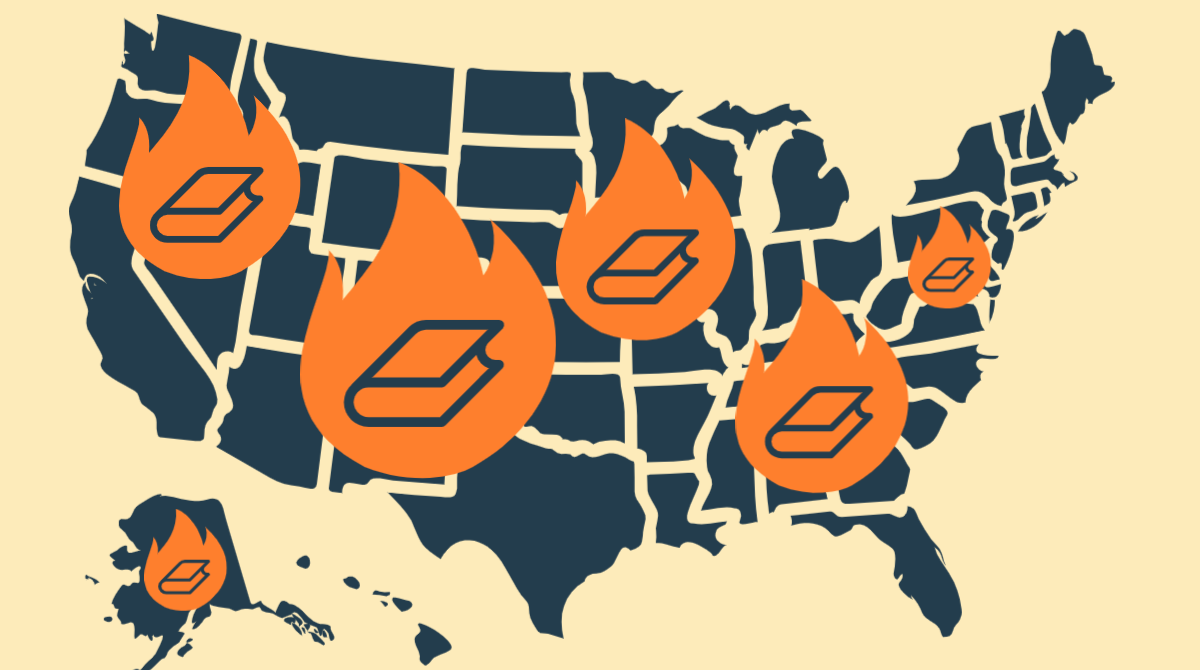
Libraries and schools across the country are experiencing unprecedented levels of attempts to ban or remove books from their shelves. I Love Libraries will continue to raise awareness by highlighting attempts to censor library materials, as well as efforts by librarians, parents, students, and concerned citizens to push back against them. This update includes news from Utah, New Hampshire, and New Jersey, as well as a look at an Ohio author who’s fighting back against book bans.
Become a Supporter
Utah residents launch book ban club in response to state’s growing school library restrictions
Two women in Park City, Utah, are turning their frustration over Utah’s school book bans into community action, launching a book club dedicated to the very titles that have been pulled from public school shelves across the state, reports TownLift.
Monica Schaffer, a local pediatrician, and Judy Silver, a former Connecticut public school English teacher, will host the inaugural meeting of the Banned Book Babes Book Club in Park City on March 10. Stephen Chbosky’s “The Perks of Being a Wallflower,” which was banned in public schools in the state earlier this year, will be the first book discussed.
Utah has 23 titles banned from all public school libraries statewide, making it the national leader in state-mandated school book bans. The most recent addition, Stephen King’s “Bag of Bones,” was added February 13. Three titles were added earlier this year: “The Perks of Being a Wallflower,” Jodi Picoult’s “Nineteen Minutes,” and “Wicked: The Life and Times of the Wicked Witch of the West” by Gregory Maguire.
The bans are triggered by H.B. 29, a 2024 law that expanded on 2022 legislation, H.B. 374, the Sensitive Materials in Schools Act. Under H.B. 29, if three school districts or two districts and five charter schools remove a book for containing what state code defines as “objective sensitive material,” the book must be pulled from every public school in the state. The law affects more than 670,000 public school students across Utah’s 41 districts and more than 100 charter schools.
New Hampsire state senate passes book ban bill
On February 19, Republican senators in New Hampshire passed a book ban bill that violates the First Amendment according to state Democrats, reports InDepthNH.
State Republicans said Senate Bill 434 would not allow a parent to decide whether a book should be in the school library or not, but it sets up a uniformed, statewide process to ask superintendents to decide if material is appropriate. It also allows parents to appeal any decision to the school board. Sen. Debra Altschiller, D-Stratham, said the bill “flagrantly” violates the First Amendment and is too vague.
“What is age appropriate?” Altschiller said, noting it can vary from family to family. She also said the bill is unclear about what happens if more than one book is challenged and that it could be time consuming and redirect the focus from student learning.
The Freedom to Read Coalition issued a statement calling this “another book ban bill that would jeopardize students’ access to books, performances, and other school materials based on the personal politics or beliefs of one person.”
“SB 434 takes power away from our local school districts, which already have policies in place to address challenges to materials in school classrooms and libraries. By leaving decisions about literary value in the hands of a single individual, the bill excludes other voices that deserve a place at the table, like those of teachers, librarians, and other parents and kids from the community. “
Facing a mental health crisis, a New Jersey school pulled a novel from an English class
A community in New Jersey has reacted to suicide attempts by young people by removing a book from the local high school, reports NPR.
South Orange & Maplewood schools superintendent Jason Bing says at least five young people enrolled at Columbia High School (CHS) have attempted to die by suicide this year. In December, one CHS student died in an accident; another young person, enrolled at a private school but known to many CHS students, died by suicide the same month.
The School District of South Orange & Maplewood’s response to this mental health crisis was removing Junot Díaz’s novel, “The Brief Wondrous Life of Oscar Wao,” from an English class at CHS, which serves the suburban towns 15 miles west of New York City. After pushback from parents and students, the district said that parents could sign a permission form to allow their children to study the novel in class.
Bing said administrators—not parents—requested the removal of Díaz’s novel from an Advanced Placement English Literature and Composition class.
The Pulitzer Prize-winning novel has been part of the district’s curriculum since 2011. But the South Orange & Maplewood school district took issue with a scene in the book in which the title character attempts suicide. Given the climate in the community, the district felt moved to immediately recall Díaz’s book, which had already been distributed from the CHS library to Martling’s students.
“I think the impulse to protect students is valid,” said Kasey Meehan, the program director for the Freedom to Read initiative at PEN America. “If there’s a crisis happening in this district, I could see this impulse to ensure students have safe environments.”
“But over and over again,” Meehan continued, “what we hear is the impulse to protect is actually quite harmful when it removes the opportunity for students to learn, when it removes the opportunity for students to be supported. In this case, it’s removing the opportunity to offer a kind of mental health literacy to students that may actually need some language to talk about what they’re feeling.”
Ohio author pushes back against book bans
In his new book, “How to Defend Books and Why,” the Columbus, Ohio-based writer Danny Caine offers practical advice on the best ways to fight against the book bans, reports Matter News.
In his previous book, “How to Protect Bookstores and Why,” Caine incorporated stories centered on the then-developing attacks being made against book sellers and librarians, including one about the Proud Boys’ violent interruption of a Drag Story Hour in suburban Washington D.C., and another centered on city council members who took legislative steps in an attempt to defund the public library in St. Mary’s, Kansas. In that book, Caine saw the roots of a new collection focused on the importance of pushing back against book bans.
“How to Defend Books and Why: Book Bans and How We Fight Them,” traces the social and political forces that have conspired in an attempt to restrict access to books, especially books in which queer folks and people of color are represented, while also providing practical advice on the best ways to advocate against these policies.
Caine’s research led him across the country, where he explored the earliest roots of the book banning movement on a trip to San Francisco’s famed City Lights bookstore, which published Alan Ginsberg’s poem “Howl” in 1956 and then defended the work in a landmark obscenity case the following year. He spent time in New Orleans for a conference centered on the right-wing attacks being made against Drag Story Hour events across the United States, and in Brooklyn, where he met and interviewed Nick Higgins, the New York librarian behind Books Unbanned, which provides digital access to the titles being yanked from library bookshelves across the United States to readers nationwide.
Caine also visited the Toronto Women’s Bookstore which revealed to him that the problem isn’t unique to the United States.
“The creeping rise of the far right and its impact on intellectual freedom is happening all over the world,” Caine said. “And it’s not just happening in schools. The schools are a frontline. But you also have to look at prisons, and you have to look at Gaza, and you have to look at bookstores.… The far right is trying to limit the freedom to read everywhere and in many ways.”
Take action
Alarmed by the escalating attempts to censor books? Here are six steps you can take now to protect the freedom to read.
- Follow news and social media in your community and state to keep apprised of organizations working to censor library or school materials.
- Show up for library workers at school or library board meetings and speak as a library advocate and community stakeholder who supports a parent’s right to restrict reading materials for their own child but not for all
- Help provide a safety net for library professionals as they defend intellectual freedom in their communities by giving to the LeRoy C. Merritt Humanitarian Fund.
- Educate friends, neighbors, and family members about censorship and how it harms communities. Share information from Banned Books Week.
- Join the Unite Against Book Bans movement and visit our Fight Censorship page to learn what you can do to defend the freedom to read in your community
- Become a Supporter of the American Library Association and help ALA fight for libraries and everyone’s freedom to read.
Subscribe to the I Love Libraries newsletter! You’ll get news from the library world, advocacy updates, author interviews, book lists, and more delivered to your inbox every month.